
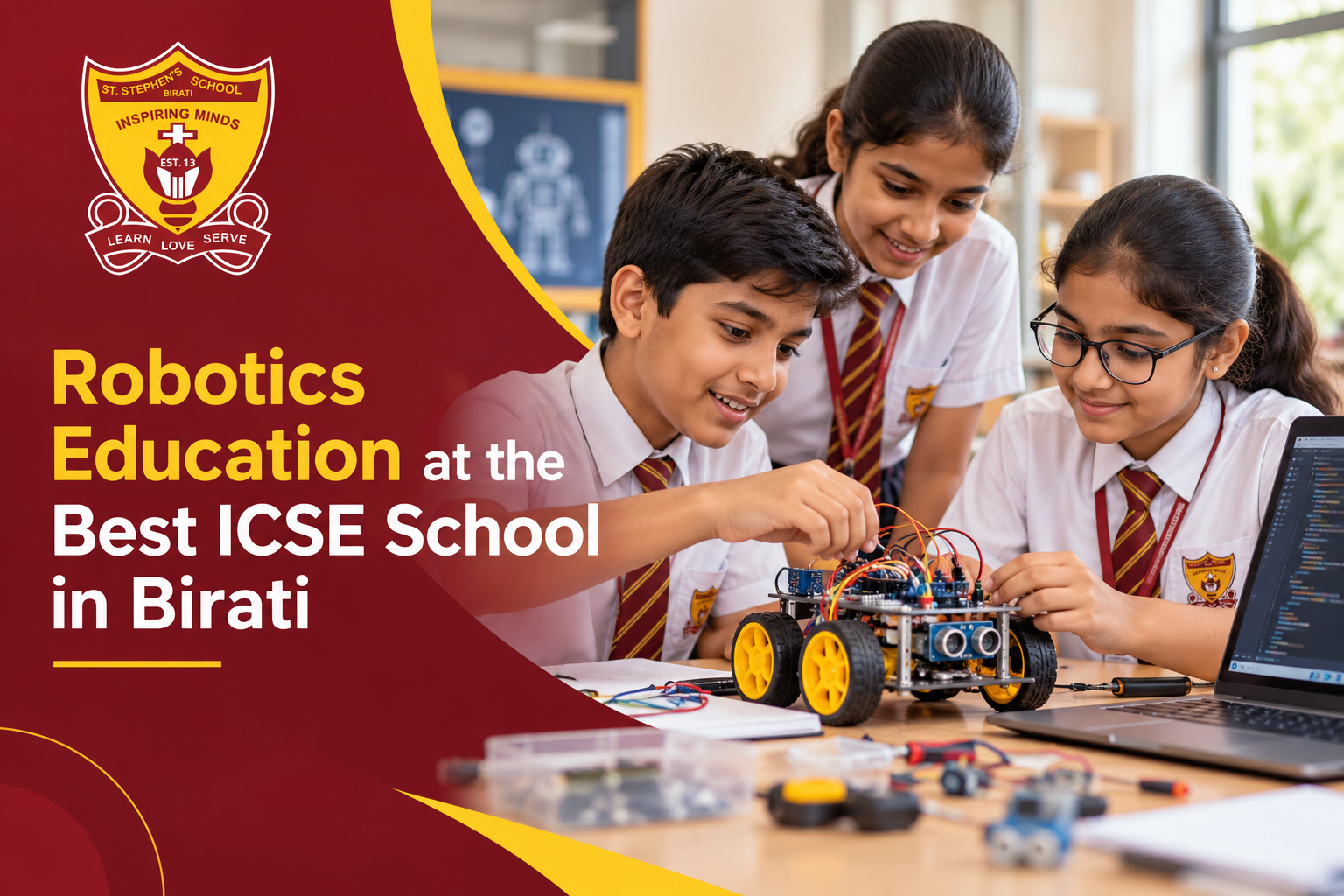
Learning becomes more meaningful when students can put knowledge into practice.
This is often neglected in day-to-day learning concepts. While concepts build an important academic foundation, understanding the concept does not always mean knowing how to apply it in practical solutions. Students also need opportunities to experiment, make decisions, and solve problems after their first solution fails.
This is where practical learning comes into play. Robotics has been a valuable part of STEM and practical learning for quite a long time, but the question here to ponder over is
What role does it actually play in developing practical learning skills? Let us explore this blog below to find the answer to this question and how St Stephen’s plays a crucial role in this.
How does robotics develop practical learning skills among students?
Robotics develops practical learning skills by allowing students to apply classroom concepts through designing, building, programming, and improving a real working system.
Instead of learning concepts only through theory, students must actively engage with problems and discover how different ideas work together. The learning process becomes more interactive as students have to think about what they are trying to achieve, plan an approach, and respond with the right solution. This encourages them to understand the process behind a solution rather than simply memorising the answer.
The value of robotics becomes even clearer when students are given opportunities to learn through experimentation and practical projects. In an ICSE school in Birati, robotics can complement the curriculum by helping students connect concepts from science and computer education with practical applications. Students can develop several important learning skills through this approach:
● Problem solving: Students learn to identify an issue, explore possible solutions, and make changes when the initial approach never works.
● Logical thinking: Programming and controlling robotic systems require students to organise instructions and understand sequence.
● Practical application: Robotics allows students to take concepts learned in the classroom and use them while designing or testing a working system.
● Experimentation: Students can test different ideas, observe the results, and improve their design based on what they discover.
When practical learning becomes a part of everyday education, students gain opportunities to understand concepts through experience as well as instruction. A learning environment that combines academics with robotics, STEM, and technology can help students build these skills progressively.
What skills can students develop through robotics education?
Robotics education can help students develop problem-solving, logical reasoning, collaboration, and practical application skills by turning theoretical concepts into hands-on learning experiences.
Here are a few skills that students can develop through robotics education:
| Skill | How robotics helps develop it |
| Problem solving | Students identify challenges and test possible solutions. |
| Logical reasoning | Programming encourages students to follow sequence, pattern, and cause-and-effect relationships. |
| Creativity | Designing a robotic system gives students opportunities to think differently |
| Critical thinking | Students can learn to fix a design or programme that is not working. |
| Teamwork | Group projects encourage students to communicate ideas, share responsibilities, and work towards a common outcome |
Students in ISC schools in Birati can complete academic learning by connecting classroom concepts with practical applications. Robotics can make subjects such as maths and science more interactive. At St Stephen’s School, robotics is a part of a broader technology and STEM-focused learning environment that also includes areas such as electronics and app development. Its greater educational value lies in helping students become more comfortable with questioning, experimenting, and improving their education.
From classroom concepts to practical applications
Robotics creates a practical bridge between what students learn in class and how these concepts work in real situations.
Science concepts can become easier to understand when students observe movement, energy, and mechanism through a working project. Maths can be applied through measurement, pattern calculations, and program logic, while computer education fused with robotics shows students the world of code differently. At St. Stephen’s School, Birati, robotics complements the school’s wider STEM-focused learning environment, giving students opportunities to engage with practical activities. With robotics, there is practical exposure to every subject, which can encourage curiosity and independent thinking.
How can robotics support a student’s overall learning journey?
Robotics can guide a student through the practical side of their learning by creating moments for them to explore ideas beyond traditional classroom instruction. When students work on practical projects, they are encouraged to ask questions and understand that every learning has a different path to take. This can make the educational path more engaging and make students feel more confident to explore different areas of study.
Here are three important outcomes of robotics-based learning:
● Greater learning confidence: Completing a project, correcting mistakes, and seeing an idea work can encourage students to approach new challenges.
● Independent thinking: Robotics provides students with chances to explore choices, test their own ideas, and understand the reason behind different solutions.
● A future-ready mindset: Exposure to robotics, coding, and STEM can familiarise students with a tech-driven way of thinking that may support their future academic and career interests.
So while choosing a school, it is worth going through the textbooks and results, but 2027-28 school sessions are all about focusing on the learning environment that brings together academics, STEM, robotics, and technology for students to enjoy the process of learning. After all, the right learning environment can shape not just what students learn, but how they think about solutions and apply them.
Conclusion
Robotics can turn learning from a largely theoretical process into an experience built around exploration and problem-solving. By designing, programming, and testing systems, students can strengthen logical thinking, creativity, and practical decision-making skills. In an ICSE school in Birati, such learning can complement academic foundations while helping students understand how classroom concepts work in real situations. With robotics, STEM, and technology integrated into education, students can gradually develop the confidence to question, experiment, and find solutions.
Want your child to learn robotics from scratch? Here is your chance